A year ago, Paris Starn was creating, testing and posting pictures of ornate and complicated pastries as an extension of her brand, Paris 99—a line of hand-sewn, scalloped silhouettes conjuring a bygone femininity, that of a (slightly more risque) 16th century picnic. Her baking was an added bonus for followers of her account: a praline paris-brest, its tan surface matching her perfectly manicured nails; soft and airy cotton candy cupcakes with cloud-like frosting; home-made croissant cake hybrids shot against a checkerboard background. The textures of the Mommy Gnome Buffalo Plaid Matching Christmas T-Shirt but in fact I love this flaky pastry, the sounds (crunchy, chewy, ASMR-friendly) and environments of these desserts were just one aspect of her Paris 99 universe. But a year ago, when the world traded pants for sweatsuits, her clothing sales plummeted, and so her cooking practice took center stage.Before COVID hit, fetishized food, the kind that decorated Paris’ grid, was hitting a saturation point. Brightly colored gelatin and monochromatic charcuterie had become the expected fodder of many an Explore page. More than just sustenance, food had been widely accepted as a medium—a place to play and to inspire. But this movement evolved because of a pandemic that kept us away from food in the physical realm. No longer were we satisfied to scroll as mere voyeurs, seeking out visually stimulating entertainment. Instead, we became more like active students, eager (or forced) to learn, to watch and to replicate as a means to provide for ourselves when dining out became less of an option.“Who knew that sourdough was going to be the big thing at the start of COVID? I didn’t. But I was ready,” Starn says of her starter that she began to foster in February of 2020. Because of the outpouring of enthusiasm for bread—a far cry from the gianduja-cream filled viennoiserie she was accustomed to posting—she began to simplify her recipes, focusing more on approachable how-tos. “I still wanted to hold onto the curated and ASMR aspect of these desserts, I just also realized that people weren’t going to want to spend three days making a cake.” For those followers who want to bake along—but don’t want to spend three days baking a cake—Starn began posting slightly simpler recipes, too: apfelstrudel, anything sourdough, and molten lava cakes that spilled out decadently in an Instagram-friendly way. Her followers began to open up to her in her DMs—thanking her for providing a new perspective on food and cooking, even confiding in her about their own complicated relationships to food. “I have people reaching out to tell me how comforting my content is, how it helps them go to sleep at night. ” Starn says. “That’s honestly the best part of all.”View on InstagramJen Monroe, on the other hand, was wary to pivot from aspirational to inspirational. But like Starn, she quickly realized at the start of the pandemic that teaching people how to actually cook might be the only way she’d make it through. “It’s definitely brought up a lot of confusing questions in terms of what I want to be doing and what it is I feel I have to offer,” says Monroe, whose art had been embedded exclusively in physical experience before COVID. “I never woke up and said I want to make weird food for a living,” she says. And yet, from pioneering the monochromatic dinner (and later ticketing the evenings as events), to unofficially trademarking the cruditable, experiential food naturally became her bread and butter over time. Her grid is a playful space filled with food that hovers at the intersection of edible and not so edible, fantasy and reality: frog pond soup with coconut herbs and nasturtium sits in a bowl made out of half of a hollowed honey-dew melon, synthesized corn pudding features cartoonish kernels that float in a scientific petri-dish. Monroe’s primary concern for her audience has always been to show how food can inspire awe, wonder and interaction, not to show how these things are made.So when COVID hit, and Monroe took to Patreon, she wasn’t sure what she should be teaching her followers, per se. “I was asking myself questions like, how much do people actually want to do what I do? Because a lot of what I do, no home cook should ever attempt,” she says. “It’s truly a stupid way to flush hours of your life down the toilet if it’s not your job.” She has found however, to her surprise, that she’s enjoyed sharing simpler recipes, and the simpler the recipe, the more engagement she gets. Her tutorial on how to make edible candles out of butter, a process she promises is easy, performed really well. “People were sending me wild interpretations, like a butter menorah!” she says. But even simpler than that, videos about how to make cabbage pancakes or kimchi fried rice have been a surprisingly gratifying way to impart some of what, at the end of the day, she loves most in the world: cooking. “I’m no Alison Roman—I’m not going to teach you how to make a pasta salad,” Monroe says. “But it’s interesting because all of a sudden people who had never cooked before are expected to provide for themselves, so I had this ah ha moment of like, oh, there is something useful I can provide. Because everyone should feel comfortable cooking for themselves.”View on InstagramAnd then there’s Alexis Nelson, aka @blackforager. Her specialty is sourcing food in unusual places (she tends to “grocery shop” through her neighborhood by pulling herbs like mustard grass from her neighbor’s yard) and making instructional videos out of it, certainly an art in our age. Like Starn and Monroe, Nelson has been surprised to find that her audience is actually eager to learn—not just watch. During COVID, she began putting a special emphasis on learning so that her followers could easily follow along when she, say, demonstrated how to properly eat an acorn. “TikTok is a quick cut game,” says Nelson, which is important when detailing, for example, how to make a seaweed panna cotta in sixty seconds (a video that’s garnered 500,000 views). Breaking things down in a way that’s accessible has never been an issue for Nelson: “I was a summer camp counselor throughout college, which, in a way, is what I channel on TikTok.” Nelson equates talking about wild food on TikTok to teaching a five-year old arts and crafts. And this formula has been working considering that this time last year, she had no followers on TikTok. Today, she has reached 1 million.View on InstagramComing in shortly after “How to eat acorns” as Nelson’s best performing post is “how to tell the difference between Queen Ann’s Lace and poison hemlock,” followed by “Black History meets Black Joy (meets more Black History).” Nelson feared that in creating a niche for herself she’d “overniche-ify” herself. “So it’s nice when you realize people are still here for me when I talk about things that aren’t plant-related.” This includes the complicated legalese around foraging and why it’s “a little bit racist!” Nelson says. And sometimes, she just wants to play the auto-harp. “I lost 25 followers after I did that but that’s fine. The autoharp is a part of the deal.”
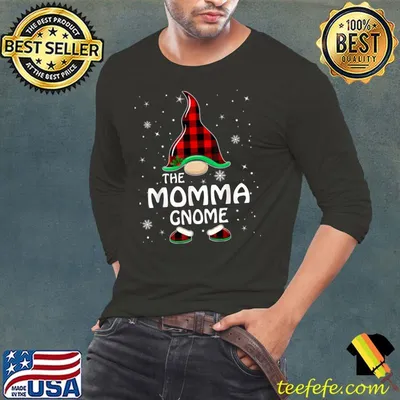
Mommy Gnome Buffalo Plaid Matching Christmas T-Shirt, hoodie, tank top, sweater and long sleeve t-shirt
Wes Gordon was 14 when he first went to Angelina, the Mommy Gnome Buffalo Plaid Matching Christmas T-Shirt but in fact I love this Parisian tearoom. He’d had a long day of sightseeing—his mother, eager to show her impressionable son Paris, left little time for rest between stops at the Louvre, Jardin de Luxembourg, and Musee d’Orsay. As he sat sipping hot chocolate, in the same chairs as historic patrons like Coco Chanel and Marcel Proust, he became overcome with the splendorous shock of it all. “I was in awe of my surroundings and, well, life,” he says.Fast forward two decades and Gordon, now the creative director of Carolina Herrera, is having similar feelings about his home of New York. After a dark pandemic hibernation, the city is now booming with a lively, infectious beauty. “Have you seen the tulips? And all the restaurants? They’re packed!” he says enthusiastically. “New York feels so special right now.”Then an idea came to him. What if, outside his brand’s flagship store on the Upper East Side, he set up his own little Angelina? A place where you could grab a coffee or a pastry, stop for a minute, and soak it all in—just like he did so many years ago? “We wanted to offer our friends a spot where they can sit, catch up, and just appreciate the wonders of this great city—our home,” he says.Today, Carolina Herrera’s partnership with the Parisian mainstay opens on Madison Avenue. “We’re offering the classics,” Gordon says of the menu. Think mini macarons, salted caramel ice cream, coffee, and of course, the designer’s beloved hot chocolate. Now, Gordon acknowledges that the rising temperatures may deter some from sipping the signature drink, so, ever the pragmatist, he’s also offering iced chocolate. The decor is classic bistro: green-and-white woven chairs sit below the pink-and-red awnings of Herrera. “It’s completely charming,” says Gordon. The pop up runs through July 31.













Reviews
There are no reviews yet.